


Bamboo Shield · 24 in


 by ProTech Plastic
Bamboo Shield Root Barrier
Helps keep running bamboo where you planted it. 24, 30 or 36 in deep, in 60, 80 or 100 mil HDPE, cut to the length you order in 5 ft steps.
Project pricing is calculated for the full continuous cut.
One continuous piece up to 175 ft. For a longer run, add another cut.
How much do I need?
Where two ends meet, they overlap 12 in. The total below includes it.
Enter your measurements to see how much to order.
Buying for a large job or by the pallet? Talk to us.
 24 in connecting kit
$23.99
each
Two 1.5 in stainless straps plus hardware. One kit per joint.
The kit goes in your cart with the roll.
- Free shipping in the lower 48
- Ships same or next business day by FedEx
- 30-day returns
How it works
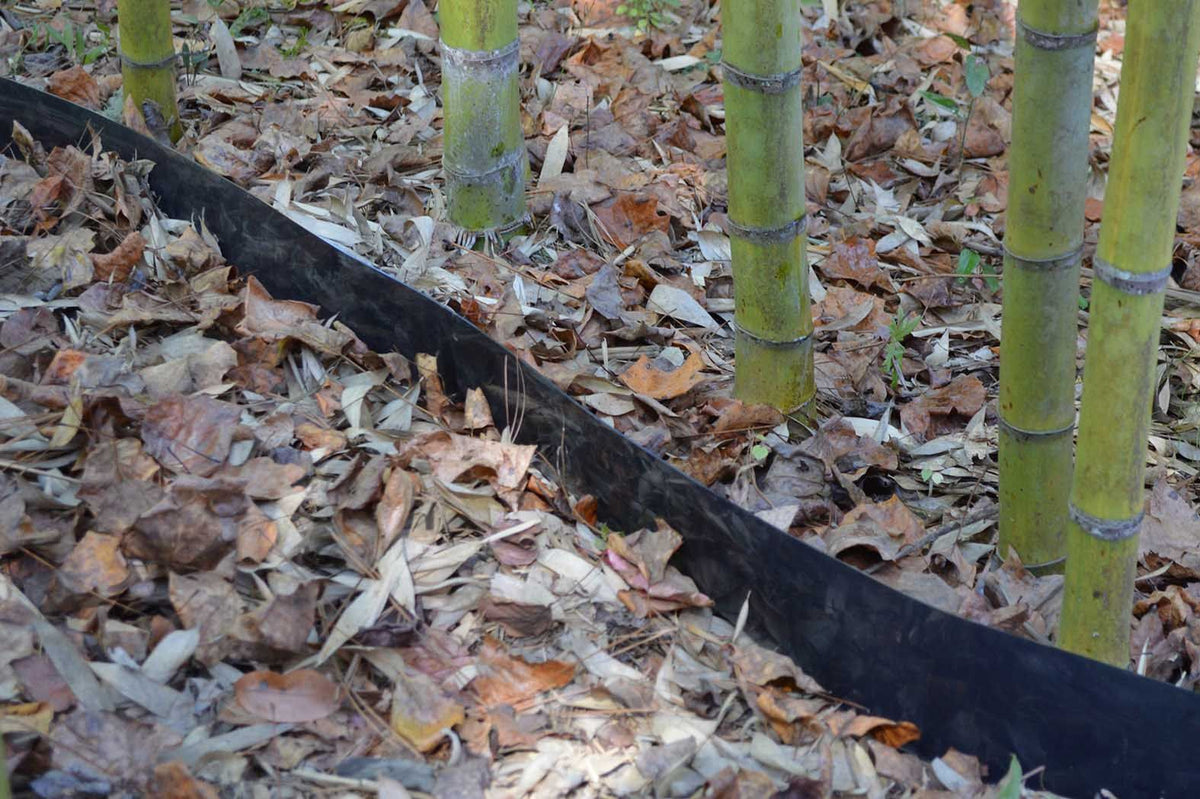
Running bamboo spreads sideways by rhizomes, and most of them stay in the top 12 to 18 in of soil. A barrier set deeper than that turns them up toward the lip, where you can see them and cut them.
Deeper than the rhizomes
Choose 24, 30 or 36 in. Each depth reaches below the top 12 to 18 in, where most rhizomes travel.
A 2 in lip above the soil
Set the smooth face toward the bamboo with the top tilted slightly outward. Rhizomes that reach it turn up toward the lip.
Clamped joints, not tape
Overlap ends at least 12 in and clamp them with the stainless connecting kit. Tape is not a seal.
Which depth do I need?
Find your USDA zone, then the size of your bamboo. Zones 4–7: 24 in for bamboo up to about 25 ft, 30 in for anything larger, timber bamboo included. Zone 8: 30 in. Zones 9–11: 36 in. Can’t name your bamboo or its mature height? Use the larger-bamboo row for your zone (30 in in zones 4–8, 36 in in 9–11).
In loose or sandy soil, go one depth deeper: 24 to 30 in, or 30 to 36 in. Already at 36 in? Stay at 36 in. To check, dig a test hole about 30 in deep at the edge of the grove, and choose the depth whose trench bottom sits at least 4 in below the deepest rhizome you find. If the test hole and the chart point to different depths, use the deeper one. Call 811 before you dig.
Most clumping bamboo spreads slowly and needs no barrier. If you want a firm edge around a clumper anyway, near a pool, foundation or property line, use 36 in.
| Depth | Thickness | Puncture resistance | Best for | Trench depth | Price | Longest piece |
|---|---|---|---|---|---|---|
| 24 in Selected | 60 mil | 130 lbf | Zones 4–7, bamboo up to about 25 ft | 22 in | $2.93/ft | 175 ft |
| 30 in Selected | 80 mil | 155 lbf | Zones 4–8, larger and timber bamboo | 28 in | $4.88/ft | 100 ft |
| 36 in Selected | 100 mil | 200 lbf | Zones 9–11, hot and tropical climates | 34 in | $6.49/ft | 70 ft |
Puncture resistance per ASTM D4833. Trench depth is the barrier depth minus the 2 in left above finished soil. Longest piece is the longest single cut we ship; for a longer run, order more than one cut.
How to install it
The short version of the install manual.
-
Mark the line and call 811
Lay out where the bamboo should stop and measure it. Call 811 before you dig.
-
Dig the trench
Dig 2 in shallower than the barrier is deep: 22 in for the 24 in barrier, 28 in for 30 in, 34 in for 36 in. Dig out any rhizome already outside the line.
-
Set the barrier
Smooth face toward the bamboo, top tilted slightly outward, with 2 in left above finished soil.
-
Join the ends
Overlap ends at least 12 in and clamp them with the stainless connecting kit, one kit per joint. Tape is not a seal.
-
Backfill and check it
Backfill and firm the soil. Once or twice a year, walk the outside of the line and cut any rhizome crossing the lip.
Specs
Material
- Material
- HDPE, over 80% recycled, made in the USA
- Thickness
- 24 in 60 mil (1.5 mm)30 in 80 mil (2.0 mm)36 in 100 mil (2.5 mm)
- Puncture resistance (ASTM D4833)
- 24 in 130 lbf30 in 155 lbf36 in 200 lbf
- Color
- Black
Sizes and ordering
- Depths
- 24 in, 30 in, 36 in
- Lengths
- Cut to order in 5 ft steps
- Minimum length
- 20 ft
- Longest piece
- 24 in 175 ft30 in 100 ft36 in 70 ft For a longer run, order more than one cut
- Shipping weight
- 24 in 0.6 lb per ft30 in 1.0 lb per ft36 in 1.5 lb per ft
Installation
- Above finished soil
- 2 in
- Trench depth
- 22 in for 24 in, 28 in for 30 in, 34 in for 36 in (barrier depth minus 2 in)
- Facing
- Smooth face toward the bamboo, top tilted slightly out
- Joints
- Overlap at least 12 in, one connecting kit per joint
Questions
How deep should a bamboo barrier be?
It goes by your USDA zone and the size of your bamboo. Zones 4–7: 24 in for bamboo up to about 25 ft, 30 in for anything larger, timber bamboo included. Zone 8: 30 in. Zones 9–11: 36 in. Can’t name your bamboo or its mature height? Use the larger-bamboo row for your zone (30 in in zones 4–8, 36 in in 9–11). Most running-bamboo rhizomes stay in the top 12 to 18 in of soil. Set with a 2 in lip, the three depths reach 22, 28 and 34 in down.
Do I need a barrier for clumping bamboo?
Usually not. Most clumping bamboo spreads slowly and needs no barrier. If you want a firm edge around a clumper anyway, near a pool, foundation or property line, use the 36 in, 100 mil depth. Not sure which kind you have? Plan for running bamboo.
What if my soil is loose or sandy?
Go one depth deeper: 30 in instead of 24 in, or 36 in instead of 30 in. Already at 36 in? Stay at 36 in.
How do I check how deep my bamboo’s rhizomes go?
Dig a test hole about 30 in deep at the edge of the grove. Choose the depth whose trench bottom sits at least 4 in below the deepest rhizome you find. The trench bottom is the barrier depth minus the 2 in lip: 22 in for 24 in, 28 in for 30 in and 34 in for 36 in. Example: if the deepest rhizome is 20 in down, the trench bottom must be at least 24 in down, so choose 30 in (a 28 in trench). If the test hole and the chart point to different depths, use the deeper one. Call 811 before you dig.
Does thickness matter: 60, 80 or 100 mil?
Each depth comes in one thickness, so you choose by depth: 24 in is 60 mil, 30 in is 80 mil and 36 in is 100 mil. In the ASTM D4833 puncture test they measure 130, 155 and 200 lbf. Thickness is only one part of the job. Depth, clamped joints and a clear 2 in lip matter too.
How much should stick out of the ground?
Leave 2 in above the finished soil. Dig the trench 2 in shallower than the barrier: 22 in for the 24 in barrier, 28 in for 30 in and 34 in for 36 in. The lip is where you spot a rhizome trying to cross, so keep mulch, soil and leaves off it.
Which way should the barrier lean?
Set the smooth face toward the bamboo and tilt the top slightly away from it. Rhizomes that reach the barrier turn up toward the 2 in lip, where you can see and cut them. If you are blocking a neighbor’s bamboo, the smooth face points at their side and the top leans toward your yard.
How do I join two pieces?
Overlap the ends at least 12 in and clamp them with the stainless connecting kit: two 1.5 in stainless straps plus hardware, one kit per joint. Tape is not a seal. Add 12 in to your order for each joint, and use one continuous piece when the run allows it.
How many feet should I order?
Measure the full barrier line, add 12 in for every joint where two ends overlap, and round up to the next 5 ft. A closed loop has one joint for each piece. The “How much do I need?” calculator above does the math for straight runs, rectangles and circles.
How much barrier do I need for a 20 by 30 ft planting?
The loop is 20 + 30 + 20 + 30 = 100 ft. In one piece it has one joint, so 100 + 1 = 101 ft, rounded up to 105 ft. At 24 in, order one 105 ft cut and one connecting kit. At 30 or 36 in, the longest piece is 100 or 70 ft, so the loop takes two pieces and two joints: 100 + 2 = 102 ft. Order two cuts that add up to 105 ft, such as 55 and 50 ft, and two kits. The calculator splits a run into equal cuts, so it shows 2 × 55 ft = 110 ft; either works.
Can I order the exact length I need?
Close to it. We cut one continuous piece to the length you order, in 5 ft steps, from a 20 ft minimum. The longest piece is 175 ft at 24 in, 100 ft at 30 in and 70 ft at 36 in. For a longer run, order more than one cut and clamp them together.
Why is there a longest piece?
Each cut ships as one box, and boxes stay under 110 lb. Deeper, thicker barrier weighs more per foot: about 0.6 lb at 24 in, 1.0 lb at 30 in and 1.5 lb at 36 in. That sets the longest piece at 175, 100 and 70 ft. For a longer run, order more than one cut and clamp them together.
Is this HDPE strong enough?
Bamboo Shield is HDPE made in the USA. Judge it by the test: in ASTM D4833 puncture testing it measures 130 lbf at 60 mil, 155 lbf at 80 mil and 200 lbf at 100 mil. Each depth lists its result in the specs on this page.
What upkeep does it need?
Once or twice a year, walk the outside of the barrier line and cut any rhizome that crosses the lip. Keep mulch and soil off the 2 in lip, so a rhizome crossing it is easy to see.
Bamboo is already past where I want the line. Now what?
Dig out every rhizome outside the line, before or while you set the barrier. No depth stops a rhizome that is already outside, and bamboo left there keeps growing until you remove it.
What do shipping and returns cost?
Shipping is free, and we ship to the lower 48 states only, by FedEx Home Delivery or FedEx Ground. Orders placed before 2 pm Central on a business day usually ship that day; later orders ship the next business day. You can return an order within 30 days of delivery, cut rolls included, if it is unused and uninstalled. You pay the return shipping, and we refund your original payment within 5 business days of receiving the return. If something arrives damaged, email photos to hello@protechplastic.com within 7 days of delivery and we will send a replacement.
Also from ProTech Plastic

Root barrier designed to turn tree roots down and away from sidewalks and paving.
From $2.77/ft
Shop Sidewalk Shield
10 in tall edging barrier that helps keep spreading grass out of garden beds.
$2.16/ft
Shop Grass Barrier
UV-stabilized HDPE wrap for dock and pier pilings, 48 in wide.
$4.00/ft
Shop Pier Protector


Doing a big job?
Landscapers, nurseries and contractors: tell us the site and the footage, and we will help with depths, pallet quantities and spec questions.