


Install manual
How to install Bamboo Shield
Call 811 before you dig. Pick the depth by your USDA zone and the size of your bamboo, then dig a trench 2 in shallower than the barrier is deep. Set Bamboo Shield in it with the smooth face toward the bamboo and the top tilted slightly outward, and leave 2 in above the soil. Overlap each joint at least 12 in and clamp it. Then backfill, and check the line once or twice a year.
Before you dig
- Call 811 before you dig. Wait until buried utilities are marked.
- Decide where the bamboo should stop.
- Dig a test hole about 30 in deep at the edge of the grove. Choose the depth whose trench bottom (barrier depth minus 2 in) sits at least 4 in below the deepest rhizome you find. If the test hole and the chart point to different depths, use the deeper one.
- Dig out any rhizomes already past the line, before or while you set the barrier. No depth stops a rhizome that is already outside.
- Plan where joints will fall, in places you can reach to clamp them.
Tools and materials
Tools
- Spade or trencher
- Tape measure
- String line or garden hose to mark the line
- Drill and wrench for the connecting kit
- Work gloves
Materials
- Bamboo Shield in your depth, cut to your length
- One connecting kit per joint: two 1.5 in stainless straps plus hardware
What to order
Order Bamboo Shield by the foot in 5 ft steps, with a 20 ft minimum, and one connecting kit for every joint. Choose the depth by your USDA zone and the size of your bamboo. Most running-bamboo rhizomes stay in the top 12 to 18 in of soil. Most clumping bamboo spreads slowly and needs no barrier.
Choose a depth
| Depth | Use it for | Dig the trench | Longest piece | Order |
|---|---|---|---|---|
| 24 in, 60 mil Order 24 in | Zones 4–7, bamboo up to about 25 ft | 22 in | 175 ft | Order 24 in |
| 30 in, 80 mil Order 30 in | Zones 4–8, larger and timber bamboo | 28 in | 100 ft | Order 30 in |
| 36 in, 100 mil Order 36 in | Zones 9–11, hot and tropical climates | 34 in | 70 ft | Order 36 in |
- Find your USDA zone, then the size of your bamboo. Zones 4–7: 24 in for bamboo up to about 25 ft, 30 in for anything larger, timber bamboo included. Zone 8: 30 in. Zones 9–11: 36 in.
- Can't name your bamboo or its mature height? Use the larger-bamboo row for your zone (30 in in zones 4–8, 36 in in 9–11).
- Loose or sandy soil: go one depth deeper (24 in to 30 in, 30 in to 36 in). Already at 36 in? Stay at 36 in.
- Dug a test hole? If it and the chart point to different depths, use the deeper one.
- Not sure whether it runs or clumps? Plan for running bamboo.
- Sold by
- The foot, in 5 ft steps
- Minimum order
- 20 ft
- Overlap per joint
- 12 in or more
- Connecting kits
- 1 per joint
Work out your length
- Measure the full barrier line in feet.
- Count the joints. Every place two ends meet is a joint, including where the ends of a closed loop meet.
- Add 1 ft (12 in of overlap) for each joint.
- Round up to the next 5 ft. If that is longer than the longest piece for your depth, order more than one piece and add 1 ft for each extra joint.
Example: a 30 ft by 20 ft grove is 30 + 20 + 30 + 20 = 100 ft around. At 24 in, one piece will do, with one joint where the ends meet: 100 + 1 = 101 ft, so order 105 ft and one 24 in connecting kit. At 30 in, the longest piece is 100 ft, so the loop takes two pieces and two joints: 100 + 2 = 102 ft. Order two cuts that add up to 105 ft, such as 55 ft and 50 ft, and two 30 in connecting kits. The calculator on the product page splits a run into equal cuts, so it shows 2 × 55 ft = 110 ft; either works.
The “How much do I need?” calculator on the Bamboo Shield page does this math for you.
Connecting kits
One per joint, matched to the barrier depth. Each kit has two 1.5 in stainless straps plus hardware.
Steps
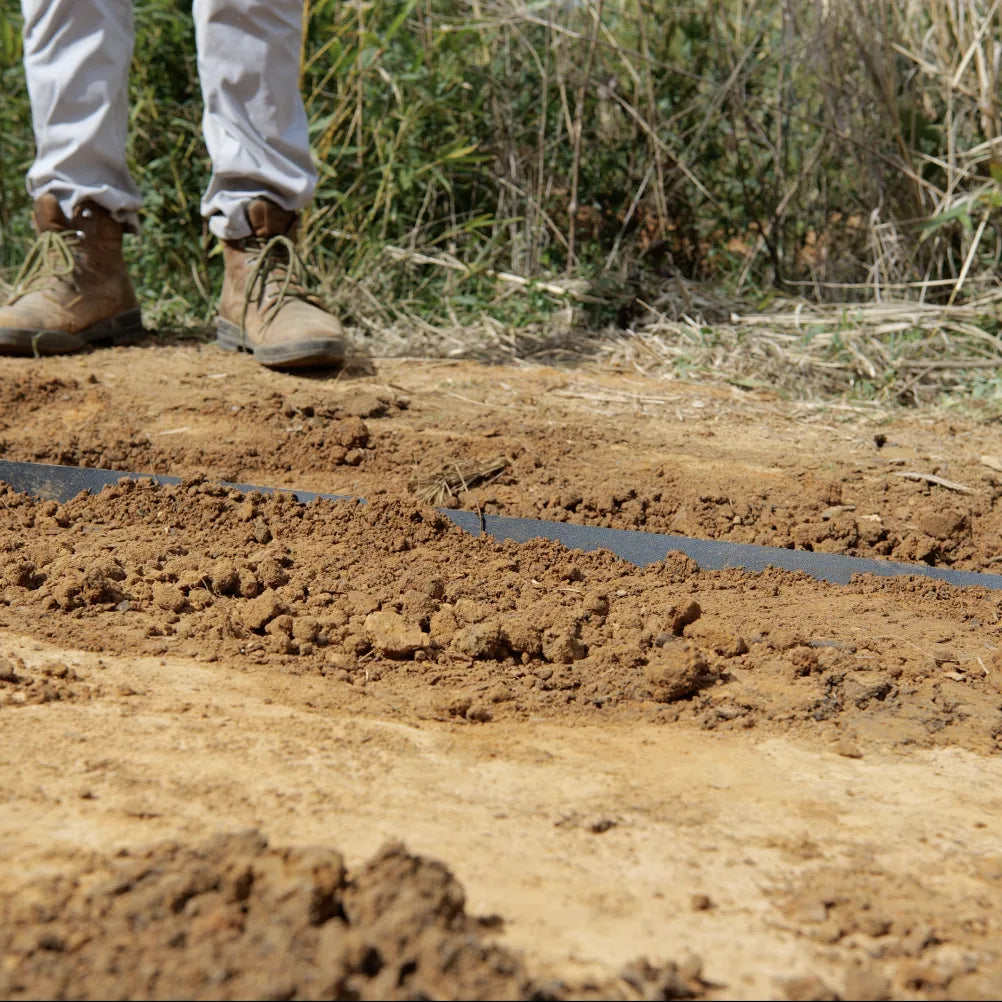
-
Mark the line
Run a string line or garden hose where the bamboo should stop, and measure it.
-
Dig the trench 2 in shallower than the barrier
Dig 22 in deep for the 24 in barrier, 28 in for 30 in and 34 in for 36 in. Pick out rocks and sharp roots along the trench.
-
Set the smooth face toward the bamboo
Tilt the top slightly outward, away from the bamboo, and leave 2 in above finished soil. Rhizomes that reach the barrier turn up toward this lip, where you can see and cut them.
-
Overlap and clamp each joint
Overlap the ends at least 12 in and clamp them with the stainless connecting kit, one kit per joint. Tape is not a seal.
-
Backfill and firm the soil
Fill the trench and firm the soil as you go, so the barrier keeps its tilt and its 2 in lip.
Check your work
- 2 in of barrier shows above finished soil all along the line.
- The smooth face is toward the bamboo, and the top tilts slightly outward.
- Every joint overlaps at least 12 in and is clamped with a connecting kit.
- The soil is firm on both sides, with no gaps or sunken spots along the line.
Maintain
- Once or twice a year, walk the outside of the barrier line and cut any rhizome that crosses the lip.
- Keep mulch and soil off the 2 in lip, so rhizomes crossing it are easy to see.
- Bamboo that was already outside the line keeps growing until you dig it out.
Questions
How deep do I dig the trench?
2 in less than the barrier depth: 22 in for the 24 in barrier, 28 in for 30 in and 34 in for 36 in. That leaves a 2 in lip above finished soil.
Which side faces the bamboo?
The smooth face. Tilt the top slightly outward, away from the bamboo, so rhizomes turn up toward the lip, where you can see and cut them.
Can I tape the joints instead of using the kit?
No. Tape is not a seal. Overlap the ends at least 12 in and clamp them with the stainless connecting kit, one kit per joint.
Which depth should I use?
Find your USDA zone, then the size of your bamboo. Zones 4–7: 24 in for bamboo up to about 25 ft, 30 in for anything larger, timber bamboo included. Zone 8: 30 in. Zones 9–11: 36 in. Can't name your bamboo or its mature height? Use the larger-bamboo row for your zone (30 in in zones 4–8, 36 in in 9–11).
What if my soil is loose or sandy?
Go one depth deeper: 24 in becomes 30 in, and 30 in becomes 36 in. Already at 36 in? Stay at 36 in.
How do I check how deep the rhizomes go?
Dig a test hole about 30 in deep at the edge of the grove. Choose the depth whose trench bottom sits at least 4 in below the deepest rhizome you find. The trench bottom is 22 in for the 24 in barrier, 28 in for 30 in and 34 in for 36 in. If the test hole and the chart point to different depths, use the deeper one. Call 811 before you dig.
Some bamboo is already past the line. Will the barrier stop it?
No. Dig out those rhizomes before or while you set the barrier. No depth stops a rhizome that is already outside.
Do I need a barrier for clumping bamboo?
Usually not. Most clumping bamboo spreads slowly and needs no barrier. If you want a firm edge around a clumper anyway, near a pool, foundation or property line, use 36 in. Not sure which kind you have? Plan for running bamboo.
Ready to order?
- Free shipping to the lower 48 states
- Orders before 2 pm Central on a business day usually ship that day
- 30-day returns
Bamboo Shield by ProTech Plastic · protechplastic.com/products/bamboo-shield · Reviewed October 2026